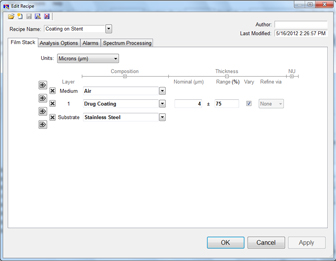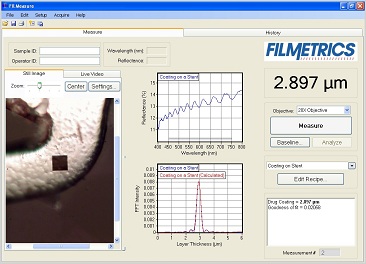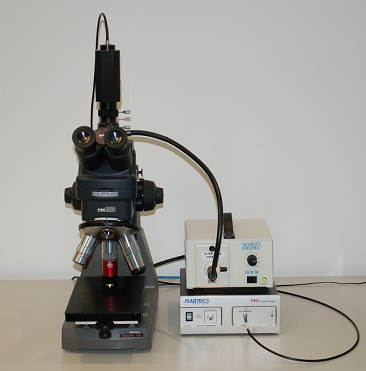
F40 with 20x objective
Coatings in Biomedical Device Applications
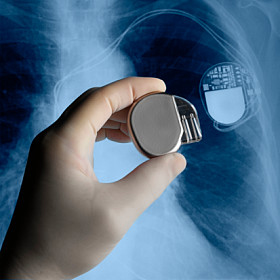
There are many types of coatings used in the manufacturing and preparation of biomedical devices. Some coatings protect the device from corrosion while others protect from complications such as tissue trauma, infection, or even rejection. Drug delivery coatings are also becoming common. Other biomedical devices, including angioplasty balloons, are freestanding membranes that must be of uniform and fixed thickness in order to function properly.
Thickness measurement methods of biomedical coatings vary, but one thing is certain - the most commonly used methods (such as weighing a part before and after coating) do not detect incomplete coverage or coating non-uniformities that can lead to device failure.
The Filmetrics® Advantage
Filmetrics offers a broad range of solutions for measuring coated biomedical devices:
- Stents: The small coated-areas of stents usually require a microscope-based instrument. Our F40 is used in dozens of labs to measure thickness of passivation and/or drug-delivery coatings. A special stent fixture for convenient rotational positioning during measurement is available.
- Implants: Irregularly-shaped surfaces are generally the only challenge when measuring coatings on implants. Filmetrics has a full line of probes for this application.
- Guide Wires & Needles: Like stents, these devices often benefit from microscope-based instruments such as the F40.
- Catheter and Angioplasty Balloon Wall Thickness: Thickness greater than 100 microns and visible-spectrum opacity both mean that the F20-NIR is the preferred instrument for this application in large number of labs worldwide.
Contact our thin-film experts to discuss your biomedical device thickness measurement application.
Filmetrics offers free trial measurements - results are typically available in 1-2 days.
Search Applications
Biomedical Device Film Thickness Measurement Example
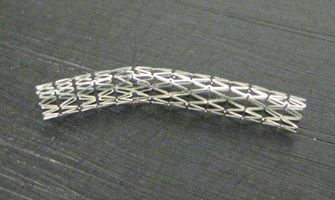
Stents are small tubes made of plastic or metal which are inserted within blood vessels to prevent constriction. Many times, these stents are treated with a polymer or drug coating to enhance functionality and corrosion-resistance. Using our F40 instrument along with 20x objective (25µm spot size), we are able to measure the thickness of these coatings along the outer diameter of a stainless-steel stent. This powerful instrument offers those in the medical device industry a system capable of fast and reliable thickness measurements that is non-destructive and requires no sample preparation.